
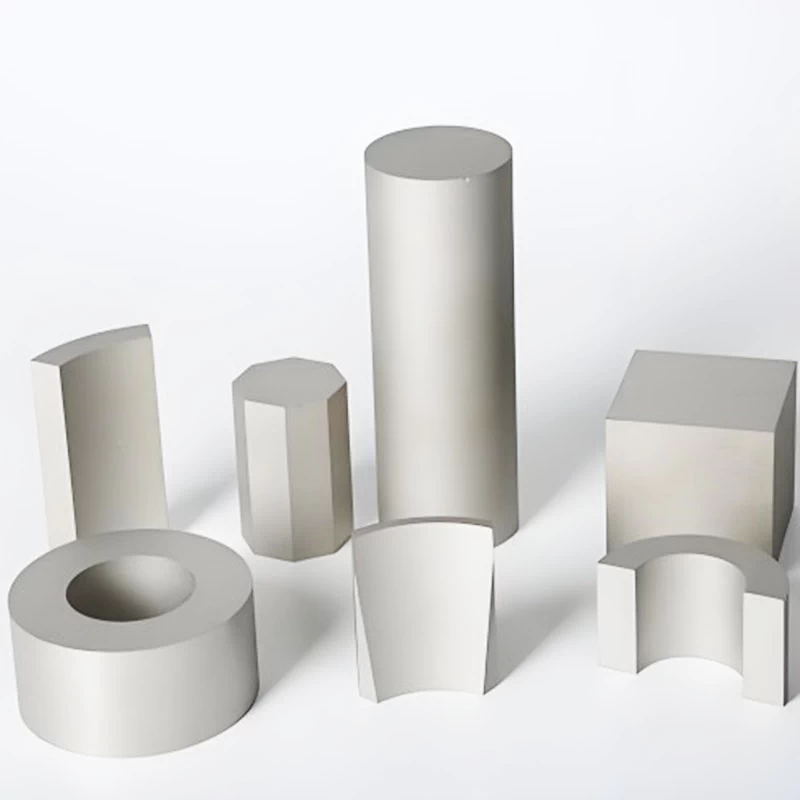
Samarium cobalt magnets, or SmCo magnets for short, were the first commercially available magnetic material. Like neodymium iron boron magnets, they belong to the rare-earth permanent magnet category. However, their magnetic properties differ significantly from those of neodymium iron boron magnets. They offer a wider operating temperature range, superior temperature coefficient, and stronger corrosion resistance. Their maximum operating temperature can reach 350°C, with no negative temperature limit. At operating temperatures above 180°C, their maximum energy product (BHmax), coercivity, temperature stability, and chemical stability all surpass those of neodymium iron boron permanent magnets.
Energy Product: Neodymium iron boron (NdFeB) magnets have a high energy product of 52 MGOe, which is 1.6 times that of Samarium cobalt (approximately 32 MGOe), resulting in stronger magnetism.
Composition: NdFeB contains neodymium (29-32.5%), iron (64-69%), and boron (1.1-1.2%); Samarium cobalt is mainly composed of samarium (23-28%) and cobalt (48-52%), with a small amount of iron (14-17%).
Operating Temperature: The maximum operating temperature of NdFeB is approximately 220℃, while that of Samarium cobalt can reach 350℃; at temperatures exceeding 180℃, the magnetic stability of Samarium cobalt is significantly better than that of NdFeB.
Temperature Coefficient: The remanence temperature coefficient of samarium cobalt (-0.03~-0.05%/℃) is much lower than that of neodymium iron boron (-0.11%/℃), resulting in less magnetic loss at high temperatures.
Corrosion Resistance: Due to its high cobalt content (approximately 65%), samarium cobalt is naturally corrosion-resistant and usually does not require electroplating; neodymium iron boron is easily oxidized and requires electroplating for protection.
Machining Characteristics: Both are brittle, but neodymium iron boron is easier to machine.
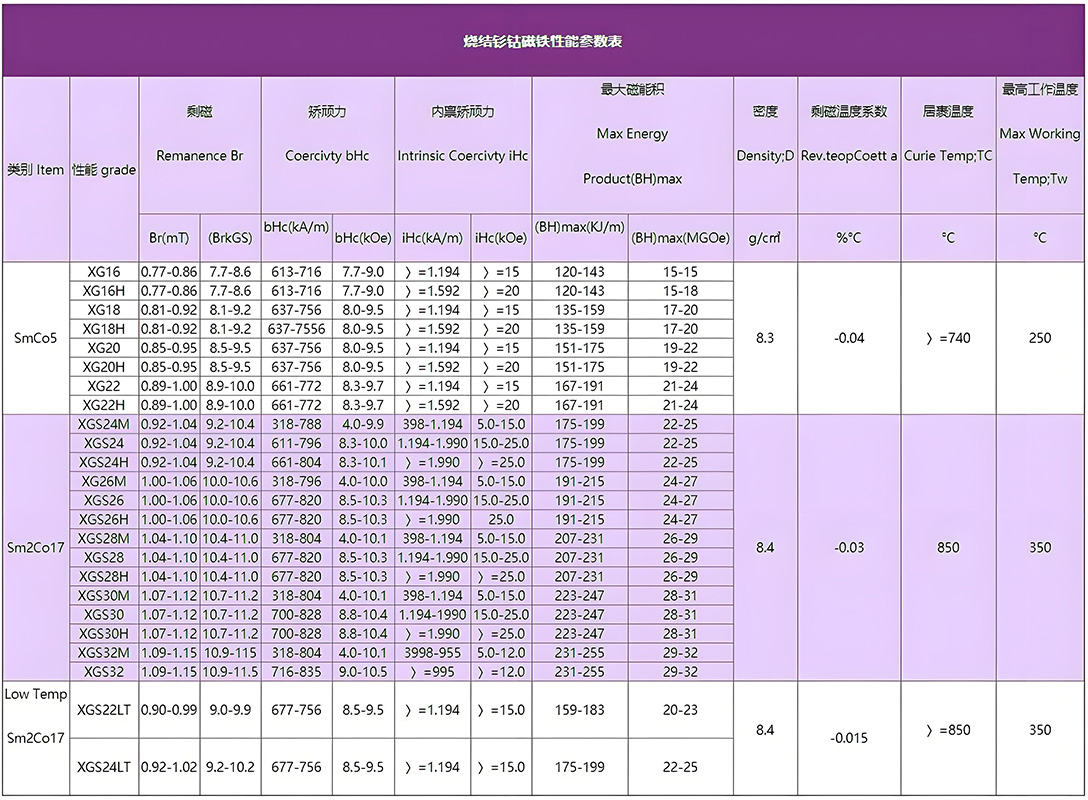
You can refer to the performance parameter table of samarium cobalt magnets below. Understanding the two types of samarium cobalt magnets and their high-temperature resistance parameters will help you choose the appropriate type.
Due to their thermal stability, samarium cobalt magnets are the preferred magnets for many demanding applications in manufacturing, automotive, and aerospace industries, such as electric motors and generators. Samarium cobalt magnets are also more corrosion-resistant and less prone to demagnetization than neodymium magnets because they contain little or no iron. However, like neodymium magnets, they are very hard and very brittle, meaning they are easily shattered and broken upon direct impact with hard metals.
The disadvantage of samarium cobalt magnets compared to neodymium magnets is their higher cost due to the production cost. Because of their properties, samarium cobalt magnets are most commonly used in applications requiring high-temperature operation, such as generators, pump couplings, sensors, motors, marine applications, and in the automotive, aerospace, military, food, and manufacturing industries.
In summary: If high temperature requirements are needed, samarium cobalt magnets are the better choice; if high magnetic performance is required, neodymium iron boron magnets are the better option.
You can get a price of this model or send us any question to get any information you would like to know, we will reply to you soonest.