

Search

Rubber Soft Magnet

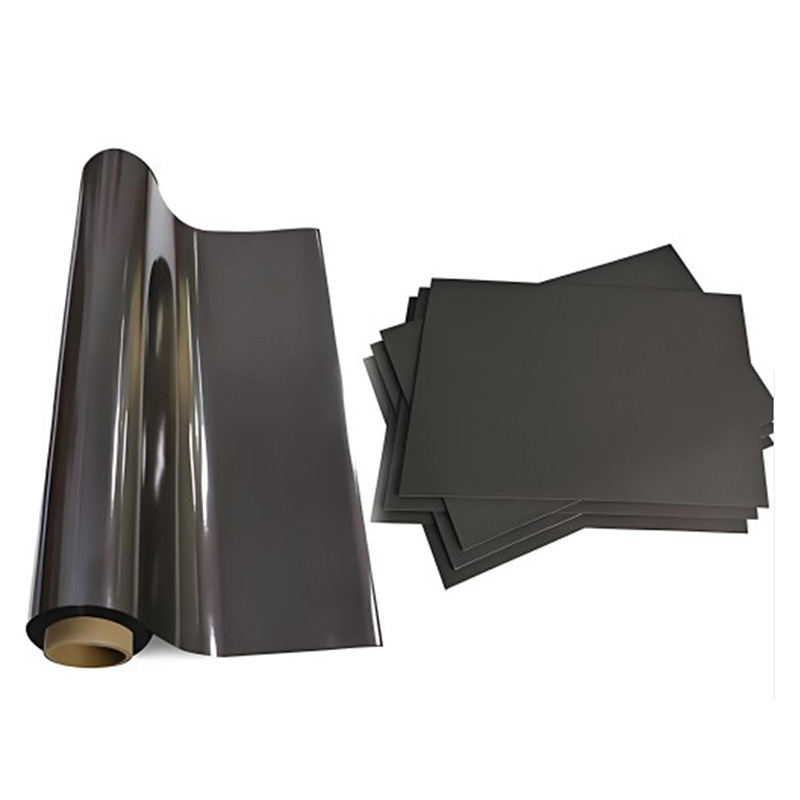
Rubber-coated soft magnets are made from rubber, magnetic powder, liquid silicone, and additives through calendering and vulcanization processes. The manufacturing process incorporates an environmentally friendly technology that uses liquid silicone instead of epoxy resin as an adhesive. The product exhibits a specific gravity of 3.8 cm³/g, a hardness of approximately 85 degrees, and a magnetic strength of 550-750. It is wear-resistant, pressure-resistant, has a high surface finish, and its thickness is precisely controlled within the range of 0.3-10 mm. It can be manufactured in single- or double-sided magnetized forms and cut into rolls or sheets. Soft magnetic rubber is a new type of magnetic material with high magnetic permeability and good flexibility and plasticity, and is widely used in electronics, communications, medical, and automotive fields.

Descriptions

Main Parameters and Applications of Rubber Magnets:

Magnetic Parameters

  1. Permeability: The permeability of soft magnetic rubber magnets is generally between 1000-5000 Oe, several times that of traditional soft magnetic materials. This means that under the same magnetic field, soft magnetic rubber magnets can generate stronger magnetic force, thereby improving the efficiency and performance of equipment.
  2. Coercivity: The coercivity of soft magnetic rubber magnets is generally between 10-30 Oe, comparable to traditional soft magnetic materials. Coercivity is the minimum magnetic field strength required for magnetization of a material and is an important indicator of its magnetic properties.
  3. Saturation Magnetization: The saturation magnetization of soft magnetic rubber magnets is generally between 0.3-0.5 T, also several times that of traditional soft magnetic materials. Saturation magnetization is the maximum magnetization of a material and is also an important indicator of its magnetic properties.
  4. Magnetoresistance: The magnetoresistance of soft magnetic rubber magnets is generally between 1-10 kΩ·cm, several times that of traditional soft magnetic materials. Magnetoresistance is an electromagnetic property indicator of a material in electromagnetic waves, and it is also an important indicator for materials in high-frequency applications.
  5. Thickness: The thickness of soft magnetic rubber magnets is generally between 0.1-3 mm, and can be customized according to actual needs. Thickness is another important parameter of soft magnetic rubber magnets, as it determines the material’s flexibility and plasticity, and also determines the range of applications.

 Applications

  1. Electronics: Soft magnetic rubber magnets are widely used in the electronics field, such as inductors, transformers, power filters, and magnetic sensors. The high permeability and low coercivity of soft magnetic rubber magnets make them excellent in these applications, improving circuit efficiency and performance.

  2. Communications: Soft magnetic rubber magnets are also widely used in communications, such as in antennas, filters, and isolators. Their high permeability and low magnetic impedance make them excellent in these applications, improving system performance and stability.

  3. Medical Field: The primary application of soft magnetic rubber magnets in the medical field is in magnetic resonance imaging (MRI) equipment. The high permeability and low magnetic impedance of soft magnetic rubber magnets make them excellent in these applications, improving imaging quality and speed.
Menu

Get a Quick Quote

You can get a price of this model or send us any question to get any information you would like to know, we will reply to you soonest.

Update cookies preferences